
This was the golden rule I came away with from the first Holistic Management course I did while working on David and Anne Moore’s intensive dairy farm in Midleton, County Cork.
Everything I learned screamed “the water cycle is broken”. But how the hell could this be true in Ireland? We get so much rain all the time. Yet, in the summer, when I was doing the course, the ground seemed rock-hard. As the animals ran by, you could hear the thunder of their hooves echoing because the ground was like a hard pan. The whole thing was compacted.
Like most farmers, I thought this compaction was all caused by heavy machinery rolling over the ground and by animal hooves. But, I was wrong, most of it was happening from below the surface.
Everyone knows that you cannot grow grass without water. So, in a drought, you can only rely on the water that is stored in your soil. How do you store rain while it is falling so that it is available to your plants when the dry weather comes?
There are four parts to this.
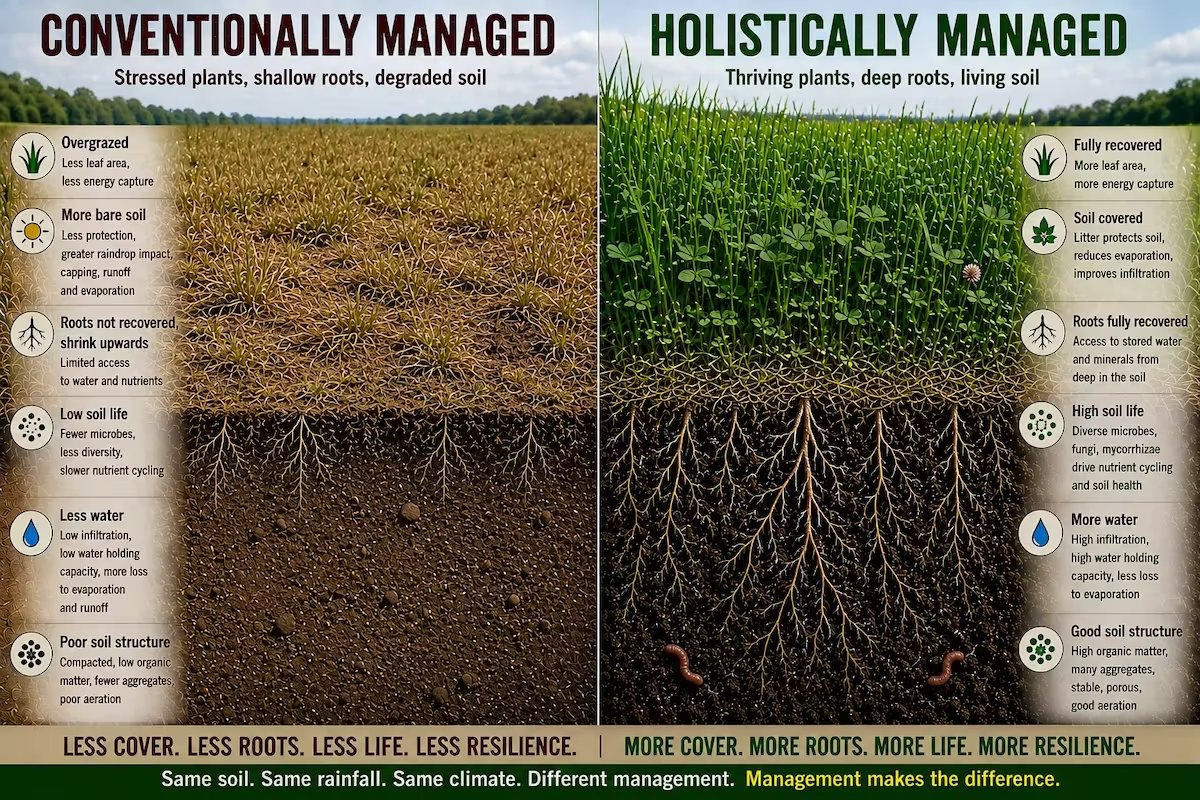
Roots and burrowing organisms open up the soil. But also, bacteria produce sticky polysaccharides and fungi weave hyphae to ball up soil particles into small bundles called aggregates. These aggregates join together to create a crumb structure like a kind of soft angular gravel, with pathways for water to flow through the surface down into the soil. If the soil surface is exposed, raindrops hit it like bombs, disturb and fill these openings with fine particles causing “capping”, which is a thin seal over the surface. This capping slows or prevents water and oxygen from entering the soil and carbon dioxide from exiting. The soil gets choked. To prevent this capping, you must protect the soil surface, with litter that is trampled as thin mulch to the surface or leave enough standing grass by not grazing as tight as “normal”. Both of these will intercept the rain drop and create a safe environment for all the organisms to maintain the soil surface. Ideally you want raindrops to hit leaves first and flow gently to the soil surface along the stems.
Now that the water can get in, you need to create a deeper soil structure and storage capacity for the water to flow underground. Growing taller plants means growing deeper roots. The tips of these roots can exert a pressure of over 150 psi to prise apart the soil and reduce compaction. Some authors have suggested that mycorrhizal fungi tips can exert even more force, while beetles, worms and countless other organisms help create a vast network of underground highways through which water can flow.
According to a July 2025 article by John Kempf, grasses, forbs and legumes put about 40% and 10% of the sugars they produce from photosynthesis into above ground biomass and reproduction respectively. Underground, grasses will store 45% of their sugars in their extensive root mass, and “give away” 5% of their sugars in “exudates” to feed the soil microbes, which in-turn make minerals available to the plants. Forbs, on the other hand, store 15% of their sugars as roots and send 35% of their sugars out into the soil as exudates.
In the same article Kempf mentions research from Christine Jones, indicating that this injection of “liquid carbon” is the major pathway through which long-term soil organic matter is formed in the soil. It is this organic matter that creates the extra surface area - alongside mineral soil particles - for water to stick to.
So, now that you have infiltrated the water, you have the spaces for it to flow into, and the organic matter for it to stick to, the dry weather comes. For your plants to use this stored water, they must have roots extending down into this storage tank to drink it up. However, by the time we get to the summer, most roots are short, because most of the plants are overgrazed in Ireland. So, what is overgrazing?
Again, according to Kempf, as a general rule, when more than 50% of a grass, forb or legume is grazed, you get approximately 25% root die-back, as the plant scavenges energy from the roots to regrow. If this plant is allowed enough time to fully recover above ground, so it can send enough energy back down and regrow the roots that died back, then these roots are retained at depth. If, however, only a short recovery time is allowed again and again through the spring, the plants are repeatedly grazed before the roots recover, so the roots will continue to shrink upwards. As they shrink upwards, the soil microbes are no longer being fed at depth, so they die off or move up, and the soil structure below collapses and “compacts” from below. Then, by the time the drought comes, you have shallow roots, dry compacted soil and dead or dormant soil biology. This is not a good place to be.
On the other hand, if you can change your management, so that you reduce the number of grazing groups on your farm, increase the stock density (not stocking rate), reduce the length of each grazing period, don’t graze as tight as “normal”, accept trampling of some grass as a good thing, and allow a longer recovery time before the next grazing, you can prepare your ground for the drought. This can begin right now, by starting to let your plants do the work of uncompacting the soil for you, and most importantly, plan to allow full root recovery before you graze for the first time next spring. Going out too early in spring is often the first mistake and can set you back for the whole year.
There is of course more detail than I can squeeze into this article. There are no magic bullets, there are obviously financial constraints, and how different land will respond to different management will vary. However, if you can acquire sufficient ecological literacy about how nature actually functions - and this does not require a degree in ecology - you will begin to see your land differently. Once you do, you can plan now to grow grass in a drought.
Best regards,
Sam Fuller
3LM Ireland, Director, Accredited Professional
Helping farmers regenerate Land, Life and Livelihoods for long-term resilience
Ballinaha, Tallow, Co. Waterford